Conservation planning attempts to identify the best course of action to provide long-term protection for conservation targets identified at specific sites. It builds on an ecological summary of the site by adding the identification of conservation targets, threats (stresses and sources of stress), and recommended protection strategies and actions.
Ocean Ecology has used several freely available programs for conservation planning.
Zonation
Zonation produces a hierarchical prioritization of the landscape based on the conservation value of sites (cells), iteratively removing the least valuable cell (accounting for complementary) from the landscape until no cells remain. In this way, landscapes can be zoned according to their value for conservation. The program produces, among other things, basic raster files from each run, which can be imported to GIS software for further analysis and visualization.
Shown below is an example of a conservation ranking model created by Zonation for waters occurring within New Zealand’s Exclusive Economic Zone and having average depths less than 1950 m. Cells with the highest percentage rankings have the greatest conservation value.

Marxan
Marxan can be used for the following:
- Identify areas that efficiently meet targets for a range of biodiversity features at a minimal cost
- Use the principle of complementarity to select planning units which complement the conservation area network (the whole is more than the sum of its parts)
- Meet spatial requirements such as compactness of a reserve system
- Include data on ecological processes, threats, and condition
- Identify tradeoffs between conservation and socio-economic objectives
- Generate a number of possible solutions
The figure below shows a Marxan conservation model for Alaska based on watershed priorities.


PANDA
PANDA was developed to provide a user friendly framework for systematic protected areas network design to ArcGIS users. Through the use of PANDA, the designer can explore different hypothetical configurations of a system of protected areas within a planning area. Conservation achievements and associated costs of each scenario are based on the available data and knowledge. The designer can edit the scenario by interactively modifying the status of the planning units among 4 managed categories (Included, Protected, Available, Excluded). The designer can then explore the target table to see the resulting changes in conservation achievements of the new scenario and the associated costs.
PANDA interacts with Marxan, enabling Marxan to run over the current scenario and displaying the results in ArcGIS format. ArcGIS data files are converted to and from Marxan data files in the background. The user can then use the PANDA main interface to refine the Marxan solutions. Conservation feature distribution, cost, and Marxan irreplaceability scores can be easily mapped using the PANDA GUI.
A screenshot from PANDA is shown below.

Protected Area Tools (PAT)
PAT was designed to help overcome the technical challenges involved in the process of evaluating and filling protected area gaps. PAT is a GIS-based user-friendly tool that supports the protected area gap process by providing a utility for evaluating the land purchase/acquisition necessary to acheive the maximum return on investment in terms of overall contribution to a country’s conservation goals. It is a systematic and logical toolkit that helps planners to:
- evaluate activities or events that may be threatening habitat health
- identify a comprehensive representation of biodiversity for protection
- create an optimal solution for meeting habitat conservation goals
PAT consists of three conservation modules which operate within ESRI’s ArcGIS software:
- Environmental Risk Surface (ERS)
- Relative Biodiversity Index (RBI)
- Marxan Tools
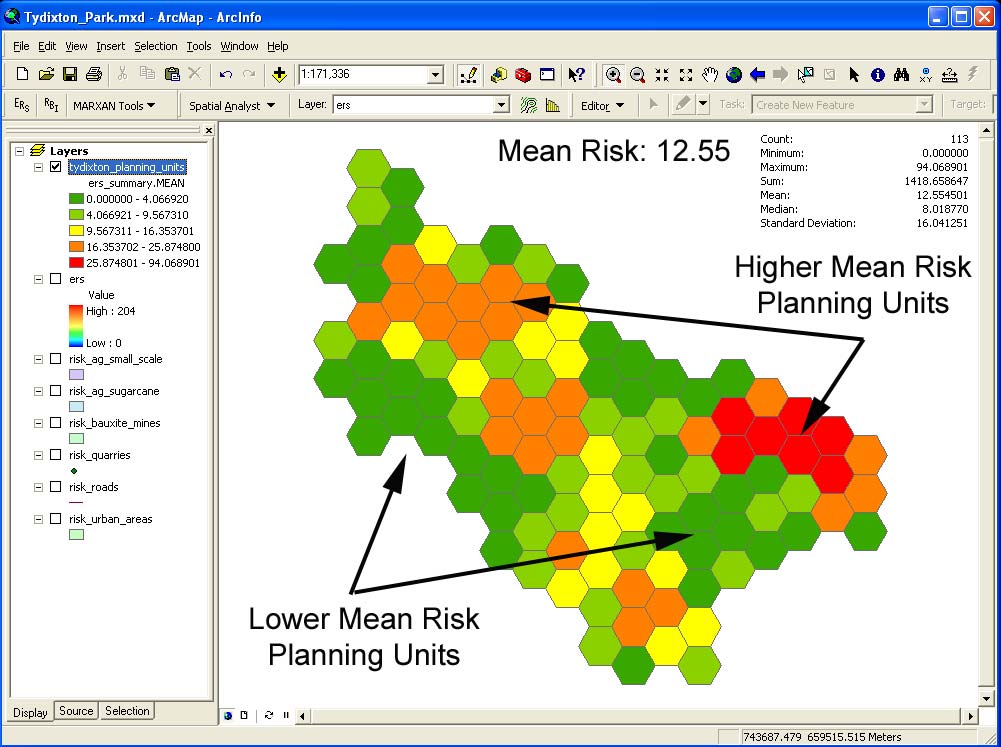
A screenshot from PAT is shown below.