ADCP Description
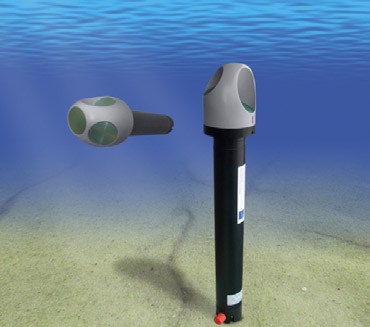
An Acoustic Doppler Current Profiler (ADCP or ADP) is a type of sonar that measures water current velocities over a range of depths.
An ADCP uses 2 or more ceramic transducers, which work in water similar to loud speakers in air. These transducers are aimed in such a way that the sound pulses they produce travel through the water in different, but known directions. As the echo of the sound is returned by small particles suspended in the water, it is shifted in frequency due to the Doppler effect.
In addition to the transducers, an ADCP typically has an accurate clock, a temperature sensor, a compass, and pitch and roll sensors. A digital signal processor (DSP) uses the ADCP sensor information to determine the Doppler shift. Trigonometry, averaging, and some critical assumptions are used to calculate the velocity of the suspended particles traveling with the water currents.
Nortek Aquadopp Profiler
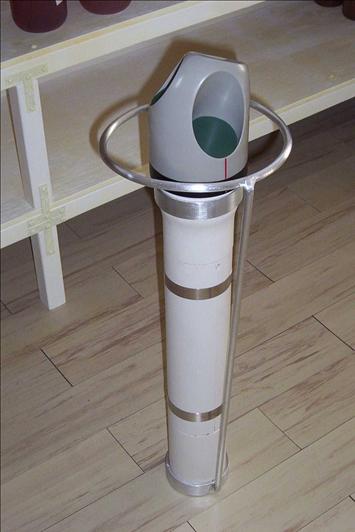
The Aquadopp Profiler from Nortek is a versatile unit which can be used for shallow water oceanography (< 50 m water depth), harbor monitoring, and scientific studies in rivers, lakes, and channels. It works well in typical ocean surface water and in the high sediment suspensions found near the coast or in rivers.
The Aquadopp Profiler uses three acoustic beams slanted at 25° to accurately measure the current profile. The internal tilt and compass sensors tell the current direction and the high-resolution pressure sensor gives the depth—and the tidal elevation if the system is fixed mounted.

Aquadopp Specifications:
Acoustics:
- Acoustic frequencies: 0.4 MHz
- Profiling range (nominal): 60-90 m
- Minimum cell size: 2 m
- Minimum blanking 1.0m
Velocity:
- Horizontal velocity range: ±10 m/s
- Accuracy: 1% of measured value ±0.5 cm/s
- Sampling rate: 1 s to several hours
Sensors:
- Compass (flux-gate, automatic up/down detection)
- Tilt (liquid level, max 30° tilt)
- Pressure (piezoresistive, resolution better than 0.005% of full scale)
- Temperature (resistive)
The Aquadopp Profiler comes with a complete suite of software for deployment planning, real time data collection and data retrieval.